

How to Read a CMA Before You List in Northwest Indiana
We’re the shop on South Main in Crown Point. Love Thy Neighbor. Call (219) 801-0432.
This page is Realest’s guide to reading a comparative market analysis (CMA) before you list in Northwest Indiana and the Illinois towns we work. Pam and Sash walk sellers through solds, actives, condition, and list-price honesty from Suite B. No invented medians. No trophy list price. Ask the shop for comps on your address.
Our office is at 112 S. Main St., Suite B, Crown Point, IN 46307. We list homes across Lake, Porter, and LaPorte counties, plus Homewood, Orland Park, Flossmoor, and Lansing when the Illinois side is in play. Start on Sell or Learn Selling when you want representation. This post is the CMA and list-price conversation, not the fix-before-list walk-through.
The Suite B call that starts with a number
A seller called last month with a number already picked. Not a range. A number. They had scrolled Zillow, talked to a neighbor who sold two summers ago, and added a little for the kitchen they love.
Pam did not argue the kitchen. She asked for the address. Sash pulled recent closed sales on that block and the next two streets. Same bed count when possible. Similar square footage. Similar age and condition story. Then he put the seller’s wish next to what actually closed.
The room got quiet in a useful way.
That is the shop habit in Crown Point, Munster, Valparaiso, Merrillville, Schererville, Dyer, Hobart, and the Illinois-line towns we work. List price is not a mood. It is a claim you make to the market. A CMA is how we test that claim before photo day.
If you still need the prep side (what buyers smell and trip on first), read What to Fix Before You List. DIY inspection walk: Seller Home Inspection Checklist. Buying and selling in the same season: Buying and Selling at the Same Time. Interviewing representation: How to Interview a Realtor. Read our offer-to-closing calendar when a file is already under contract: ask the shop for the current link if you do not see it live yet.
Crossing from Illinois into Indiana, or selling an Illinois house while you buy here? Read Illinois to Indiana relocation on Real Estate USA, then call the shop for representation.
What a CMA is (and what it is not)
A comparative market analysis is a Realtor’s priced read of your home against recent nearby sales and current competition. It is not an appraisal. An appraisal is a lender’s valuation later in a financed deal. A CMA is earlier. It helps you choose a list price that can attract showings and survive the first two weekends.
A solid CMA usually includes:
- Recent solds that actually closed (not just listing prices)
- Active listings that compete with you right now
- Pending or contingent files when the data is useful and honest
- Condition and update notes so you are not priced like a remodel you do not have
- A recommended list range, not one magical digit
A CMA is not:
- A guaranteed sale price
- A refinance “what we need to break even” number
- An online estimate pasted into a PDF
- Permission to ignore days-on-market on your street
Sash’s line in Suite B: if the CMA cannot explain why your house should beat the last three closed sales in your pocket, the list price is a hope. Hopes sit.
Want a first home-value read before the listing appointment? Start at RealestValues.com, then call (219) 801-0432 for comps from the last 60 to 90 days on your block. We do not invent a county median on this page. Process beats a number that is already stale by publish day.
How to read the solds first
Start with closed sales. List prices are wishes. Closed prices are what buyers and lenders actually finished.
1. Same pocket, not same town slogan.
A Crown Point Square-adjacent ranch and a Crown Point edge ranch can live in different buyer pools. Munster Ridge vs Calumet pockets are not twins. Valparaiso in-town and Valparaiso rural feel different on commute and land. Ask which solds are on your side of the highway, the rail, or the school-boundary line. Confirm schools by address. Do not buy or price on rumor.
2. Match the product.
Beds, baths, above-grade square footage, garage count, basement finish, age, and major updates. A finished basement is not free square footage in every buyer’s head. A three-car garage on a two-car street can matter. So can a roof year and HVAC age when buyers are writing.
3. Read the date.
A sale from eighteen months ago may not price today’s buyer pool. Ask for the window your Realtor is using and why. Spring and late summer behave differently than deep winter in Lake and Porter. Illinois-line towns can move on Chicago-job calendars. Ask.
4. Condition story, not fantasy.
If the sold had a 2022 kitchen and you have a clean 1998 kitchen, you are not that sold. Adjust down in your head before you argue up. If you have the better roof and the dry basement, say so with proof. Photos and service records help more than adjectives.
5. Net vs brag.
Sellers remember the list price they saw on a yard sign. Agents should talk about what closed after credits, seller concessions, and repair negotiations when that data is known. Ask your Realtor what “sold” actually meant on each line.
Actives and expireds tell you the weather
Solds tell you what worked. Actives tell you what you are fighting this week. Expireds and withdrawn listings tell you what the market refused.
Actives:
If three similar homes are listed within a short drive and two of them look sharper in photos, your list price has to earn the showing. Overpricing into a crowded pocket is how you become the quiet weekend.
Expireds / withdrawn:
Quiet histories matter. Sharp buyers and their Realtors read listing history. A house that sat and cut price twice teaches the next buyer to wait. Starting honest often costs less than a public education on your MLS history.
Days on market honesty:
DOM is not a moral grade. It is feedback. A well-priced home in a liquid pocket often sees early traffic. A dream price often sees polite silence. We do not invent a “normal DOM” number for all of Northwest Indiana on this page. Ask the shop what your micro-pocket has been doing lately.
Overpricing vs right-price (say it out loud)
Overpricing feels safe.
It feels like leaving room to negotiate. In practice it often filters out the buyers who would have written in week one. The people who remain may lowball because the listing looks soft.
Right-price feels scary.
It means putting a number that comps can defend. It usually means more showings, cleaner footing in multiple-offer moments when the market allows them, and less story on the listing history.
Price cuts after quiet weekends.
A cut can work. It also announces that the first number was wrong. Two cuts teach patience to the wrong audience. Pam would rather have the hard conversation on day zero than manage a slow bleed.
Appraisal reality on financed deals.
Buyers who need a loan need value that an appraiser can support with solds. A list price far above the sold cluster can survive a cash buyer. It often struggles when the majority of your buyer pool is financed. Your Realtor should say which pool your pocket actually has.
List-price checklist before you sign the paperwork
1. Bring the address, not only the wish.
Suite B starts with the parcel and the product. Wish comes second.
2. Ask to see the sold set.
Not a summary slide. The addresses, close dates, and why each one made the cut.
3. Ask which actives you will compete with on Saturday.
If you cannot name them, you are pricing in the dark.
4. Separate prep spend from price.
Fixing what buyers smell and trip on is a prep job. Read What to Fix Before You List. Do not confuse a paint weekend with a $40,000 bump the comps will not carry.
5. Decide your walk-away and your next-home clock.
If you must sell to buy, say it. Contingencies and timing change which list strategy is sane. Read Buying and Selling at the Same Time.
6. Put the range in writing.
List low of range, list mid, list stretch. Know which one you are choosing and why. Stretch needs a reason the solds can carry.
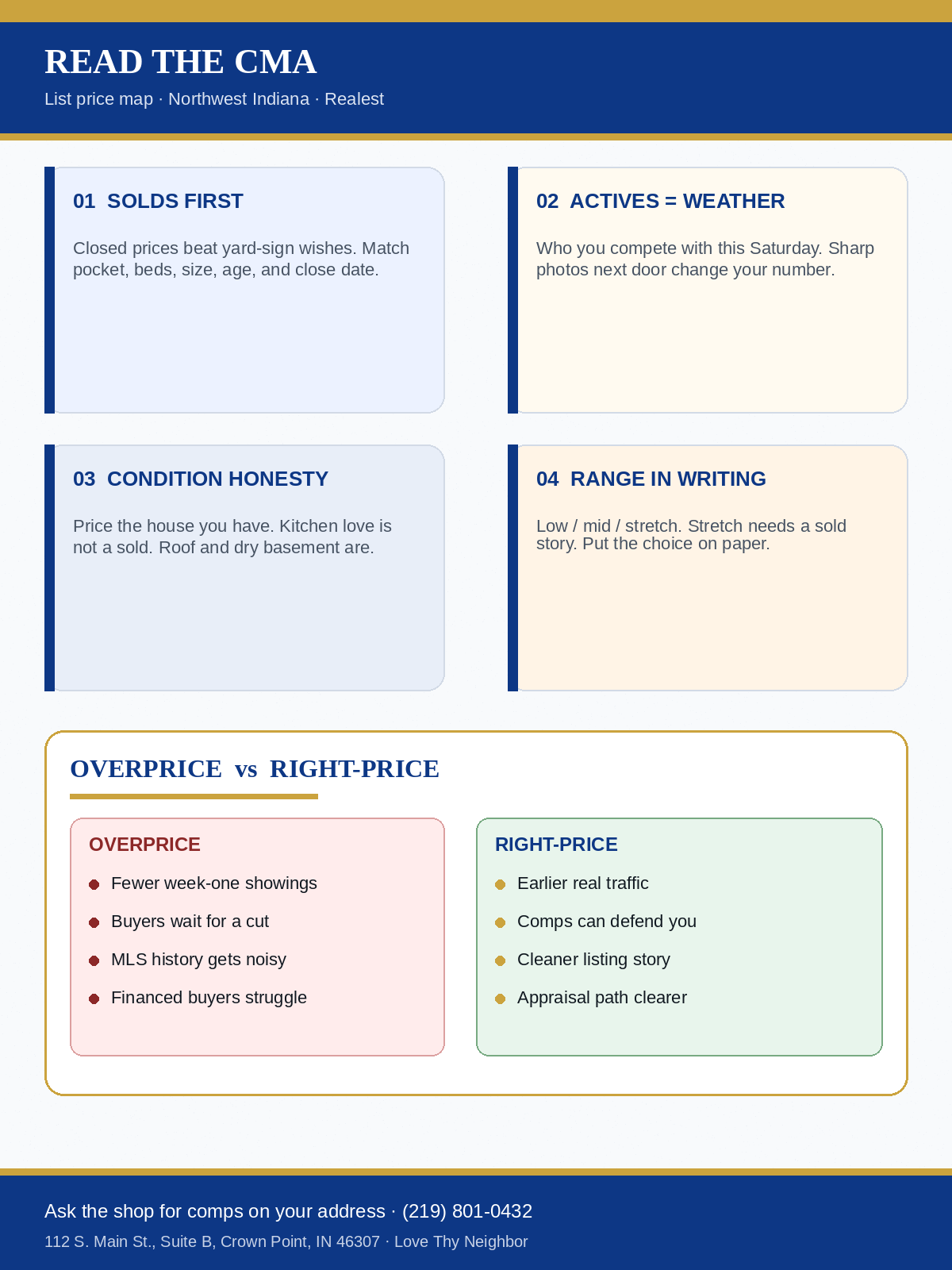
CMA map: solds first, actives as weather, condition honesty, right-price vs overprice.
Honest tradeoffs
Stretch list vs early traffic.
A stretch can work when inventory is thin and your condition is clearly best-in-pocket. It fails when you are average condition in a crowded pocket. Ask which case you are in.
Waiting for spring vs listing when you must move.
Seasonality is real. So is a job start date in Orland Park or a lease end in Homewood. Timing pride should not strand you into a worse carry cost. Ask the shop for a calendar that matches your life, not a slogan.
Online estimate vs Suite B comps.
Estimates are a starting whisper. They miss condition, pocket nuance, and this week’s actives. Use them to open the conversation. Do not tattoo them on the listing agreement.
Illinois seller pricing an Indiana buy (or the reverse).
Tax proration habits, buyer pools, and lender underwriting can differ across the line. Read the USA relocation guide, then keep representation local to each file: Illinois to Indiana relocation.
Who this CMA read fits (and who should slow down)
Fits people who:
are 30 to 90 days from listing, can look at solds without taking them personally, want showings more than a yard-sign brag, and will tell the shop the truth about condition and timeline.
Should slow down if:
you need a specific payoff number that comps cannot support, you have not walked your own house like a buyer yet, or you are still deciding whether to sell and buy in the same month without a Plan B. Read the same-time guide and call (219) 801-0432 before you fall in love with a stretch price.
Soft doors while you price
Browse Sell for representation. Keep studying on Learn and Learn / Selling. Message the desk on Contact. Meet the shop on About. Search live inventory at Search homes on Realest.com when you are also buying. Related shop reads already linked above: fix-before-list, seller inspection checklist, same-time buy/sell, and interviewing a Realtor.
FAQ
What is a CMA in real estate?
A CMA is a comparative market analysis. Your Realtor compares your home to recent nearby solds and current competition to recommend a list-price range. It is not an appraisal. Call Realest at (219) 801-0432 for comps on your address.
How is a CMA different from an appraisal?
A CMA helps you choose a list price before you go live. An appraisal is usually ordered later by a lender on a financed purchase. Both look at solds. They serve different moments in the file.
Should I price at the top of the CMA range?
Only when condition, updates, and this week’s actives support it. Stretch pricing without a sold story often means fewer showings and a louder price-cut later. Ask the shop which line of the range fits your pocket.
What happens if I overprice my home in Northwest Indiana?
You can sit. Buyers and their Realtors skip to better-priced comps. Listing history can show price cuts. Starting closer to defended solds usually costs less pride than a slow public education on the MLS.
Do online home-value estimates replace a CMA?
No. Use them as a conversation starter. Then ask a Realtor for solds, actives, and condition adjustments on your block. Start at RealestValues.com if you want a first whisper, then call (219) 801-0432.
How do I reach Realest about a CMA before I list?
Call (219) 801-0432 or visit 112 S. Main St., Suite B, Crown Point, IN 46307. Email saso@realest.com. Start on Sell, Learn / Selling, or Contact. Hours 9am-8pm daily. Love Thy Neighbor.
Talk to the shop
Realest: 112 S. Main St., Suite B, Crown Point, IN 46307
(219) 801-0432 | saso@realest.com
Hours 9am-8pm daily. Love Thy Neighbor
Related Posts

Loan Estimate in Crown Point: How to Compare Mortgage Offers Side by Side
A Loan Estimate in Crown Point is the three-page form every lender…

Lead Paint Disclosure in Crown Point: What Pre-1978 Home Sales Require
Lead paint disclosure in Crown Point applies to most home sales where…

Seller Rent-Back in Crown Point: Staying After You Close
A seller rent-back in Crown Point lets you stay in the home…